





Coach Mark Wetmore and leading runner Adam Goucher provide important points of focus, but the team setting keeps the account from becoming only a star's biography. Cross-country is scored collectively even though each athlete must manage his own effort. That combination produces a distinctive tension. A runner's private physical condition has consequences for teammates, while the expectations of the group become part of the pressure carried into a race.
The Shelf · Books
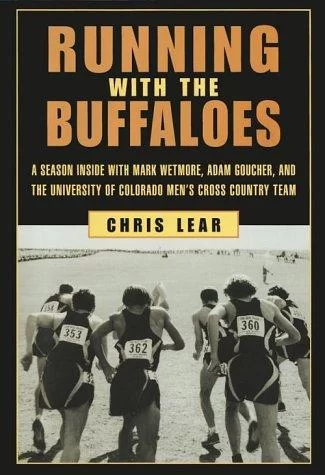
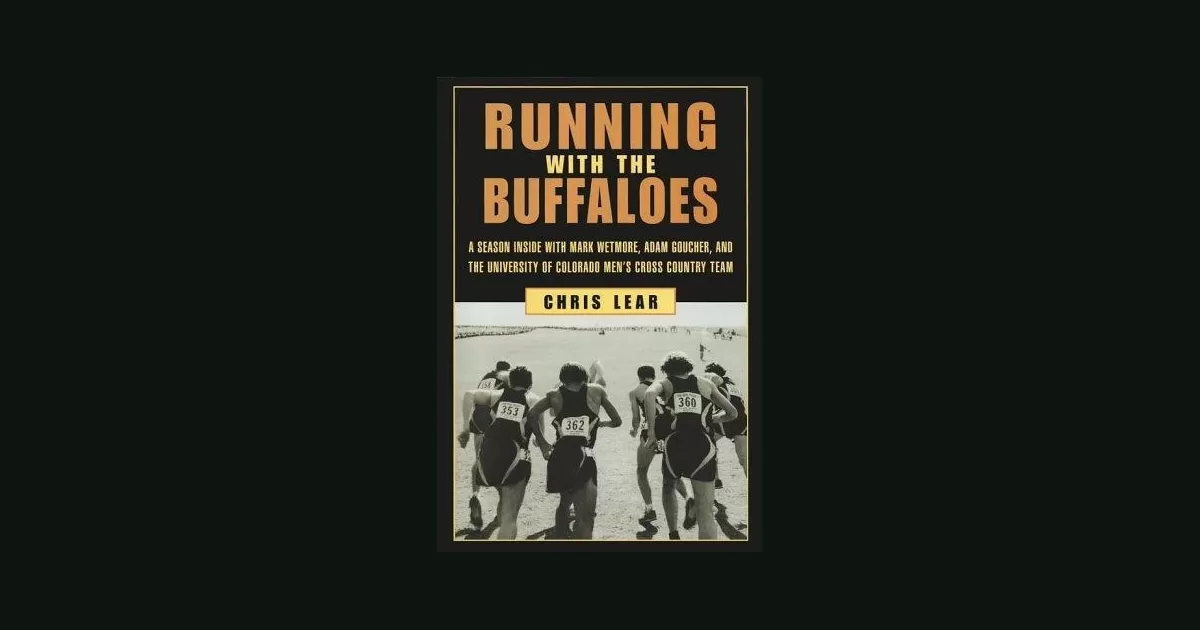
Running with the Buffaloes
By Chris LearReleased 2000Curated by SPMA Hub because sport culture lives beyond the field.
Running with the Buffaloes gives a season of college cross-country the attention usually reserved for a championship afternoon. Chris Lear follows the University of Colorado men's team through its 1998 campaign, placing training, fatigue and relationships alongside the races. The book's strength is the cumulative view: performance emerges from weeks of shared work rather than arriving as an isolated expression of individual will.

The Shelf
The Gist
Why it caught our attention
The Details
Quick facts
- Format
- Book
- Author
- Chris Lear
- Published
- 2000
- Genre
- Non-Fiction
- Relevant Sport
- Running

At A Glance
Running with the Buffaloes gives a season of college cross-country the attention usually reserved for a championship afternoon. Chris Lear follows the University of Colorado men's team through its 1998 campaign, placing training, fatigue and relationships alongside the races. The book's strength is the cumulative view: performance emerges from weeks of shared work rather than arriving as an isolated expression of individual will.

About This Shelf Item
About Running with the Buffaloes
Lear's close access allows the season to develop through ordinary days as well as decisive ones. Workouts matter because they reveal what the athletes are trying to build and how they interpret progress. The reader sees the uncertainty between preparation and result. A strong session can encourage confidence without guaranteeing a good race, and a difficult day can acquire different meaning when placed inside the longer pattern of a demanding programme.
The death of teammate Chris Severy gives the season a gravity that cannot be explained through competitive ambition alone. Grief becomes part of the life of the team, not an obstacle that a later result can neatly resolve. Reading the account responsibly means allowing that loss to remain human. Athletic achievement may provide a shared focus, but it does not turn bereavement into a device whose purpose is to make a sporting ending more satisfying.

Why It Belongs
The Sport Connection
For SPMA readers, the book raises concrete questions about the daily environment of a high-performance programme. Expectations are communicated through routines, feedback and the example set by other athletes, not only through a formal statement of values. Lear's season-long frame makes those influences visible. It encourages attention to how a culture is experienced by the people inside it, including those whose names do not lead the public account of a team's success.
The training detail also invites a careful distinction between understanding and imitation. A programme designed for this group at this point in its development is not automatically suitable for another runner. The more useful management question is how coaches interpret individual responses within a collective plan. That includes recognising uncertainty, responding to difficulty and deciding what information athletes feel able to share when they want to prove that they belong on the team.

Our Recommendation
Why Read Running with the Buffaloes
Distance runners are likely to recognise the significance of small changes in form, mood and confidence. Readers unfamiliar with cross-country can use the book to understand why a sport that appears simple from the sidelines occupies so much mental space for its participants. The race distance is fixed, but the athlete's experience of that distance is shaped by everything that has happened during the days and weeks leading up to it.
The account is particularly useful for discussing the difference between collective purpose and identical experience. Athletes can share a coach, schedule and uniform while carrying different needs and expectations. A team story becomes more convincing when it allows those differences to remain visible. That is also why sustained reporting matters: it can reveal developments and tensions that would be difficult to detect during a short visit timed around a major competition.
Final Thoughts
Alex's Final Thoughts
Running with the Buffaloes makes a cross-country season feel like a lived period of time. Lear's attention to work, uncertainty and loss gives the eventual results a fuller context. The book belongs on the sport shelf because it shows the emotional and practical density behind a seemingly straightforward contest, while asking readers to take the daily lives of college athletes as seriously as the performances those lives produce.
Keep Exploring
Similar Books on The Shelf











Same sport
More Running on The Shelf








Stay in the loop
Follow SPMA
New jobs, interviews and sport-industry news in your feed.






Hiring now on Sports Hired
58225283 new jobs in sport this week
Teams, leagues, agencies and brands in Canadain the USAin Canada & the USA are hiring. Find your next role, or let new ones come to you.
3701,0541,424 open jobs3,8668,20712,073 organizations
Just posted
 Policy Analyst & Committee LeadSport, Physical Activity and Recreation Council (SPARC) · within Canada3 hrs ago
 Head Coach, Synchro 9 National TeamSkate Canada · Ottawa, ON4 hrs ago
 Analyst | AnalysteOttawa Rapid FC · Ottawa, ON4 hrs ago
 2027 Summer Camp InternFirst Tee · Richmond, VA6 hrs ago
 Triple-a Athletic TrainerDetroit Tigers · Toledo, OH7 hrs ago
 Development CoachHouston Astros · Houston, TX7 hrs ago
- Policy Analyst & Committee LeadSport, Physical Activity and Recreation Council (SPARC) · within Canada3 hrs ago
- Head Coach, Synchro 9 National TeamSkate Canada · Ottawa, ON4 hrs ago
- Analyst | AnalysteOttawa Rapid FC · Ottawa, ON4 hrs ago
Copied
